It is no secret that the Trump administration has been tightening immigration policy across the United States. For people currently in the country on a temporary visa—such as an H-1B, F-1, marriage-based status, or another dual-intent visa—understanding their Residency Options for US Visa Holders can be especially important when they are already in the middle of a green card process. Recent policy changes have left many applicants and their families reconsidering their next steps. This article provides a direct, sourced look at what has changed, why “just go home and wait” is not a practical option for many affected individuals, and which countries may genuinely be worth considering as a temporary base. We examine Mexico, Canada, Panama, and Costa Rica honestly, including the potential limitations of each option.
What Actually Changed — The May 2026 USCIS Policy Memo
On May 21, 2026, US Citizenship and Immigration Services issued Policy Memorandum PM-602-0199. For more than fifty years, foreign nationals lawfully in the US on a temporary visa — work visas, student visas, marriage-based cases, religious worker permits — have generally been able to complete their green card process from inside the country, through “adjustment of status.” The May memo reverses that as the default. Most people in this position are now expected to leave the US and complete the process through consular processing — an interview at a US embassy abroad — except in “extraordinary circumstances,” a standard USCIS has not clearly defined and is evaluating case by case.
The scale is significant: in fiscal year 2023, roughly 608,000 people received a green card by adjusting status from inside the US — close to half of everyone who received one that year. Attorneys describe the rollout as confusing, with mixed signals from USCIS about how broadly it applies. What is not in dispute is the direction: it is now harder to finish a green card case without leaving the country, and family-based and employment-based applicants — spouses, parents, children of US citizens, and skilled workers on visas like the H-1B — are squarely in scope.
Why “Just Go Home” Is Not an Option for Everyone
Here is the part of this story that gets the least attention, and it is the reason this article exists. Leaving the US to “wait it out” at home sounds simple until you look at who is actually affected.
First, the State Department has separately paused immigrant visa processing entirely for nationals of roughly 75 countries. For applicants from those countries, leaving to attend a consular interview doesn’t lead to an interview — it leads to indefinite limbo, with no visa office actively working the case. Second, many people who have overstayed their original visa — something tacitly tolerated for years given well-documented backlogs — now risk three-to-ten-year re-entry bars if they leave. For these groups, leaving isn’t a pause button. It can be closer to starting over, or worse.
Third — and this applies to almost everyone in this situation, regardless of nationality — many applicants have built careers, marriages, and children’s entire lives in the US over years or decades. “Home” isn’t a place with a spare room waiting; it’s a country they haven’t lived in as adults, where credentials may not transfer and children don’t speak the language of instruction. For a meaningful share of people affected by this memo, the honest answer to “where do I go” isn’t their country of citizenship at all. It’s a third country — stable, safe, fast to obtain real legal status in, and close enough to stay connected to whatever happens with their US case.
The Options People Are Actually Considering
In our conversations with prospective clients over the past several weeks, four countries come up repeatedly: Mexico, Canada, Costa Rica, and Panama. Each deserves an honest look — including where it falls short.
Mexico is the closest and cheapest option, and for people with strong existing ties there, it may make sense. But safety deserves a direct look. Per the US State Department’s most recent update, Mexico carries a national Level 2 advisory (“Exception increased caution”), with six states — Colima, Guerrero, Michoacán, Sinaloa, Tamaulipas, and Zacatecas — rated Level 4, “Do Not Travel,” citing cartel violence and kidnapping risk. Major hubs like Mexico City, Cancún, and Mérida sit at the lower Level 2 tier, so this isn’t a blanket condemnation — but it’s a real, government-documented risk profile worth honest consideration if family safety is a genuine priority.
Canada is the intuitive choice for many — English-speaking, close, culturally familiar. The problem is Canada’s own immigration system is under severe strain. Humanitarian and Compassionate applications currently exceed ten years in processing. Canada’s Start-Up Visa permanent residency stream — one of its own flagship investor-adjacent programs — is in the same position, exceeding ten years for existing applicants, and paused for all new applications until further notice. Roughly half of all permanent residence applications in Canada’s inventory are running past the department’s own service standards, with visitor visa and work permit backlogs well above one in four delayed. Not to mention the high refusal rates for visitor visas or work permits through overseas consulates. If your goal is fast, dependable, genuinely available legal status, Canada’s own numbers do not support that expectation for most pathways right now.
Costa Rica has long marketed itself as the safe, easy Central American choice, and for much of the last two decades that reputation was earned. The current data tells a more complicated story. Costa Rica’s homicide rate has climbed to 16.1 per 100,000, driven largely by drug trafficking violence spilling into neighborhoods where expats live. More relevant to this audience: Costa Rica’s own judicial investigation agency reports a 625 percent year-over-year increase in virtual kidnapping scams — extortion schemes specifically targeting foreign business owners and job seekers with a public online footprint, exactly the profile of many people affected by this US policy shift. Costa Rica’s newly elected president has publicly declared war on organized crime, citing El Salvador’s Nayib Bukele as her model — a strong signal that even the government acknowledges the problem is real.
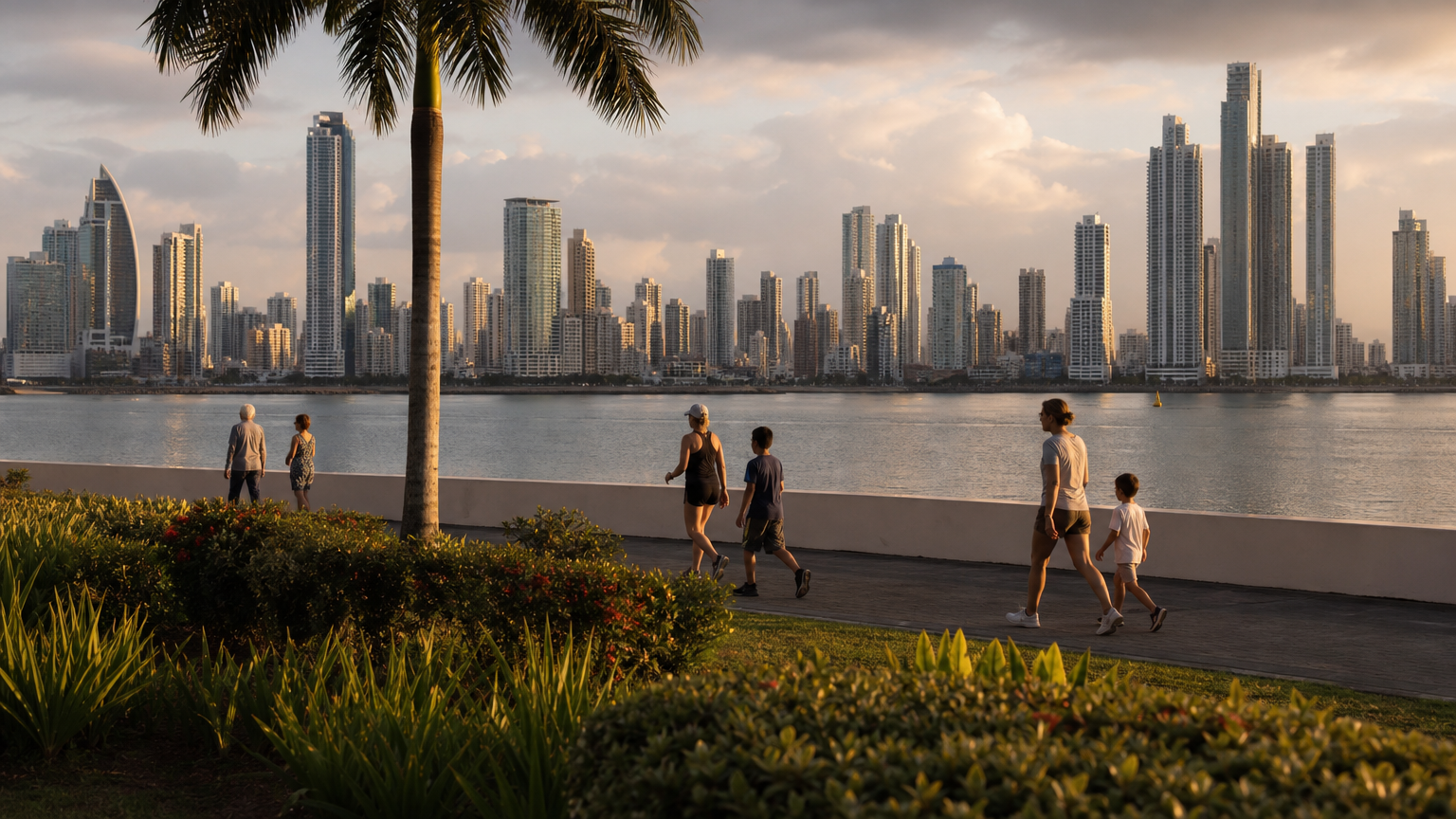
Panama is the option we believe deserves the closest look, and we say that as the firm whose business is built on it — so judge the reasoning, not just the source. Panama has no cartel-driven no-go zones, no comparable homicide spike, and no reported epidemic of scams targeting foreign professionals. It’s a stable, dollarized, English-and-Spanish business hub that has hosted a large international community for generations, long before its investment residency programs existed.

Side by Side
| Mexico | Canada | Costa Rica | Panama | |
| Safety profile | Level 2 advisory nationally; 6 states at Level 4 (Do Not Travel) | Generally safe | Rising homicide rate; virtual kidnapping targeting foreign business owners up 625% YoY | Stable, low violent crime, no cartel presence |
| Legal pathway for you specifically | No investor visa program comparable in speed | H&C and Start-Up Visa PR: 10+ years; Express Entry 6–8 months but not open to all | No investor residency program at this speed | Qualified Investor Visa: immediate PR, ~30–90 days |
| Nationality/status restrictions | None, but no fast legal pathway exists | Case-by-case; backlog and scrutiny vary by nationality | None for tourism; residency options slower and more limited | None — all nationalities eligible, no US status inquiry |
| Flight time from major US hubs | 2–3 hours | 1–5 hours | 3–4 hours | ~3 hrs (Miami), ~4 hrs (Houston) |
| Physical presence required to maintain status | N/A — no equivalent program | Varies by program; generally substantial | N/A — no equivalent program at this speed | One visit every 2 years only |
Why Panama’s Qualified Investor Visa Fits This Situation Specifically
Panama’s Qualified Investor Visa grants immediate permanent residency — not a temporary permit, not a multi-year queue — typically within 90 days of a complete application, through a $300,000 real estate investment (the reduced threshold in effect until October 15, 2026). In 2024, the program approved 327 applications with a 99 percent approval rate, a 75 percent increase in volume over the prior year. With correctly prepared documentation, this is one of the most dependable fast-track legal residencies available anywhere in the world right now.
Three features of this program matter specifically for someone navigating the situation this article describes:
- No nationality restriction, and no inquiry into your current US status. Unlike Panama’s Friendly Nations Visa, which is limited to roughly fifty designated countries, the Qualified Investor Visa is open to any nationality. Its published eligibility criteria do not ask whether you currently hold legal status in the United States or anywhere else — they ask for your age, a clean criminal record from your home country and any country you have resided in over the past five years, proof of the qualifying investment, and standard documentation. This is a genuine structural difference from Canada’s system, where nationality and case history routinely affect processing and scrutiny.
- You are not required to live there full time. Once approved, maintaining permanent residency requires only one visit to Panama every two years. This matters enormously if your situation is genuinely fluid — you can establish real, legal status in Panama as a base while keeping the flexibility to travel, work remotely, or reposition yourself elsewhere while your US case, if you choose to keep pursuing it, works through consular processing.
- Close enough to stay connected. Panama City to Miami is roughly three hours, with more than a dozen direct flights daily. Panama City to Houston is roughly four hours and fifteen minutes, also with multiple daily direct options. For a family trying to stay within reach of the United States — for business, for family, or simply for peace of mind — Panama sits far closer than Europe, the UAE, or most of the other jurisdictions marketed as investment residency options.
On the citizenship question specifically: because the Qualified Investor Visa grants permanent residency immediately, the five-year clock to citizenship eligibility begins on day one of approval — not after a preliminary temporary-residency period, as is the case under Panama’s Friendly Nations Visa, where citizenship eligibility takes seven years in total. For someone starting fresh in 2026, that is a meaningfully shorter total path to a second citizenship than almost any comparable program.
Family Considerations — Including Schooling
The Qualified Investor Visa includes a spouse and dependent children under the same application, along with dependent parents — a genuine whole-family relocation, not a piecemeal process. For families with school-age children, Panama City has hosted a substantial international community for generations, a legacy of its history as a global banking and canal-trade hub, and it maintains a range of established English-language and international-curriculum schools serving that community today. This is a materially easier transition for a family than relocating to a country with limited international schooling options, or to a jurisdiction where the language of instruction would require children to restart their education from scratch.
A Bridge, or a New Plan — Your Choice
Some readers will use Panama residency as a bridge — a stable, legal place to be while a US immigration attorney continues working their consular processing case, with the hope of eventually returning to the United States as a green card holder. Others, given the genuine uncertainty in how broadly this policy will be applied and how long it will take to resolve, will treat Panama as an independent path forward — building a real life and eventually a second citizenship there, regardless of how the US situation plays out. Both are legitimate reasons to make this move, and this article is not written to push you toward one or the other.
The October 2026 Deadline — Why Timing Is a Real Risk
It’s worth being direct about a risk that may affect the Panama Golden Visa applicants: the $300,000 real estate threshold for the Qualified Investor Visa is only guaranteed through October 15, 2026. If the government does not renew or extend Executive Decree 193 before that date, the minimum reverts to $500,000 — and this is where the risk becomes concrete rather than theoretical. Most new-construction condominiums in Panama City currently sell in the $240,000 to $350,000 range. A jump to a $500,000 threshold would push a large share of exactly the well-located, well-built inventory that qualifies today entirely out of reach, narrowing the pool of properties that both satisfy the program and make sense as a genuine investment (at this higher threshold, investors may be forced to purchase two smaller units to qualify for this program). For anyone seriously considering this route, the honest advice is to apply before the deadline, not after — waiting to see what happens in October is a bet against your own interests, not a hedge.
The good news is that acting on this timeline does not require getting on a plane. Our process includes detailed pro forma calculations on projected rental yield and return before you commit to a property, remote Power of Attorney handling the entire title transfer, and live virtual showings of qualifying units — the entire process, from property selection through residency approval, can be completed without a single visit to Panama. That said, if you would rather see the property in person, spend time in the city, or simply prefer to be physically present for part of the process, that option remains fully available — the choice is yours, not a requirement either way.
What We Do
What we do is structure fast, legitimate, alternative residency — specifically in Panama, where our in-house legal team handles the entire process end to end. If you need a genuine, stable legal base outside the United States while your situation resolves, that is precisely where our expertise sits.
Connect with INGWE Global Investment & Mobility
Website: www.ingweglobal.com
If you are affected by this policy change and want to understand your options in Panama — timeline, cost, and what your family’s specific situation requires — reach out for a confidential consultation. We will give you a direct, honest assessment, not a sales pitch.
Disclaimer: This article is intended for informational purposes only and does not constitute legal, tax, or immigration advice of any kind, and specifically does not constitute advice regarding United States immigration law or any individual’s US immigration case. INGWE Global Investment & Mobility is not a US immigration law firm and does not represent clients before US immigration authorities. Anyone affected by USCIS Policy Memorandum PM-602-0199 or related policy changes should consult a licensed US immigration attorney before making any decision about their case or about leaving the United States. Panama residency program requirements, government fees, and thresholds are subject to change; figures cited reflect publicly available information at the time of publication. INGWE Global Investment & Mobility provides advisory and facilitation services in conjunction with licensed Panamanian legal, banking, and immigration professionals.
For the latest updates, insights, and practical guidance on residency and international mobility, visit our Facebook page and stay informed about your options.
Focus: residency options for US visa holders
Secondary: Fastest second residency