
Moving your business out of Canada for taxes raises a practical question: which jurisdiction to move to. Canadian business owners weighing that decision most often compare Panama and the UAE. The two offer very different advantages. The UAE taxes a company based on where it is incorporated and applies 9% above a set threshold. Panama taxes only income earned inside Panama and leaves foreign-source income at zero. That distinction matters more than the headline rates suggest. Most profitable companies pass the UAE threshold quickly, while Panama’s exemption has no ceiling for income earned abroad.
The comparison here is fiscal rather than promotional. The figures come from the UAE Federal Tax Authority’s published guidance and Panama’s Law 25 corporate framework, as well as the direct experience of our CEO, who operates businesses in both jurisdictions. The article runs four comparisons. It sets the UAE 9% corporate tax against Panama’s territorial system. It weighs a Panama free zone against a regular Panama S.A. It places the UAE free zone next to Panama’s Colón Free Zone. And it compares a plain Panama S.A. with a UAE mainland LLC. We then look at what it takes to open and run each company from Canada, because the rate on paper and the practical reality of remote operation are separate questions. Canadian owners should always confirm their own exit and reporting position with a cross-border tax advisor before making a move.
If you are looking for guidance on your cross-border move, contact our team to map your strategy: https://www.ingweglobal.com/contact-us/
| Panama vs UAE for Canadian business owners: at a glance
• Two tax systems, two logics. The UAE taxes company residence at 9% above AED 375,000 (roughly $102,000). Panama taxes only Panama-source income and leaves foreign-source income at 0%. • Free zone rules differ. A UAE free zone must qualify for and maintain Qualifying Free Zone Person status each year. A Panama S.A. already holds the territorial benefit before any free zone permit. • The cost gap is wide. A UAE free zone setup runs about $25,000 to $35,000 a year. A regular Panama S.A. costs about $1,950 to incorporate and about $850 a year to maintain. • Remote operation differs. The UAE generally requires a residency visa and in-person banking, with a 180-day visa clock. Panama requires no visit. |
Moving Your Business Out of Canada for Taxes: Nine Percent Versus Zero
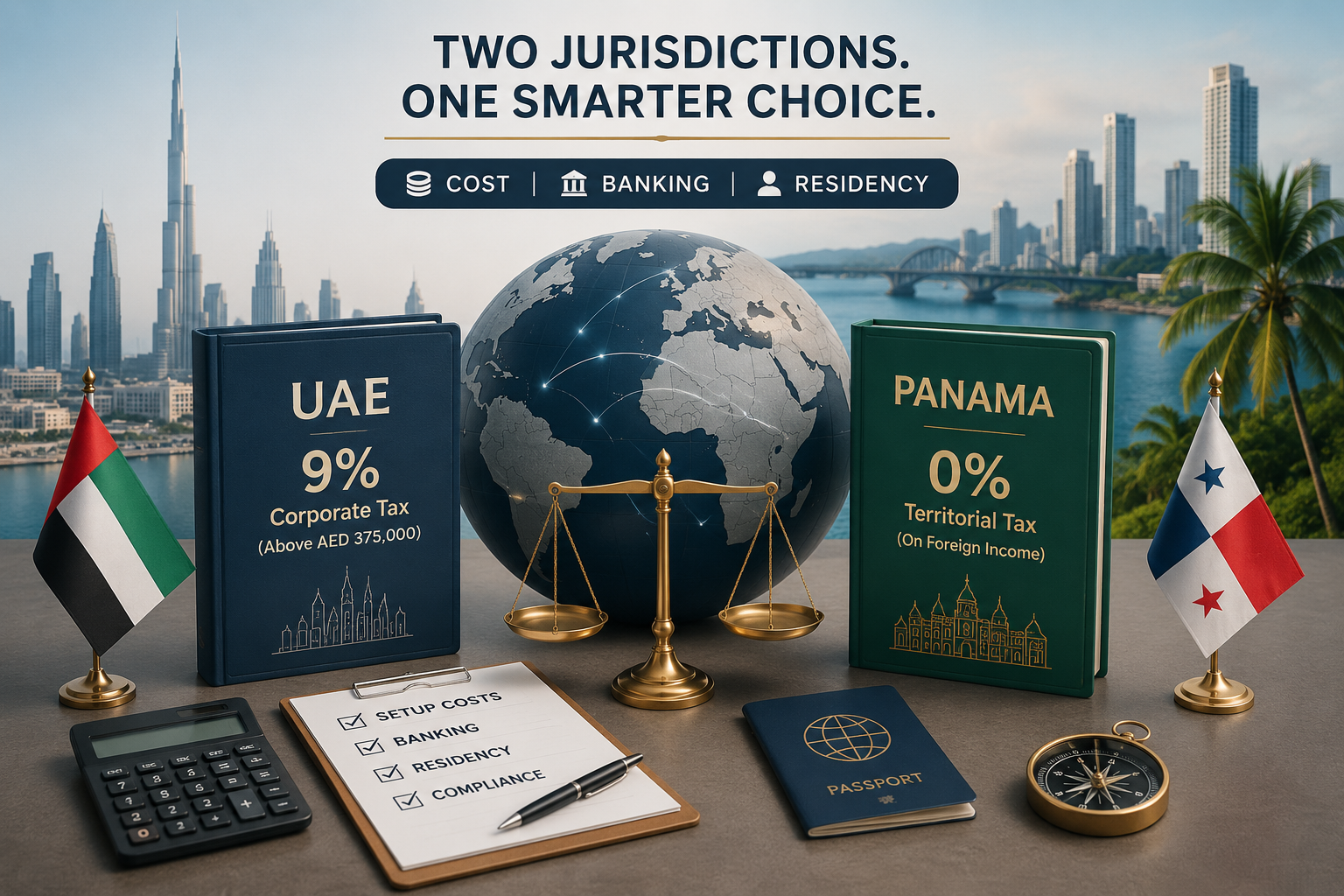
The headline choice is 9% in the UAE against 0% in Panama, but the two rates answer different questions. Under Federal Decree-Law No. 47 of 2022, the UAE applies 0% to taxable income up to AED 375,000, about $102,000, and 9% above that. By global standards, it is a very reasonable rate. The important detail is who it applies to. According to the Federal Tax Authority’s guidance, any company incorporated under UAE law, mainland or free zone, is automatically a UAE Resident Person for tax purposes. Free zone companies can apply for Qualifying Free Zone Person status to access 0% on qualifying income, but that status must be earned and maintained each year.
Panama works differently. It does not ask whether a company is resident. It asks where the income was earned. Foreign-source income earned by a Panama S.A. sits outside Panama’s tax base permanently, with no threshold and no sliding scale. For an ordinary operating company, there is no substance test to access that treatment. In practice, the UAE’s 0% is a bracket, while Panama’s 0% is the standard outcome for any company whose clients and revenue are outside Panama. This is the basis of the Panama territorial tax system. For a Canadian owner whose customers are in Canada, the United States, or Europe, the UAE’s 9% corporate tax and Panama’s zero are not directly comparable line items.
One qualification applies on the Panama side, and it does not affect the typical Canadian business owner described here. Panama’s Law 526 takes effect from the 2027 fiscal year and introduces economic substance requirements. It applies only to entities that are both part of a multinational group and earning passive foreign-source income such as dividends, interest, and royalties. A standalone Panama S.A. run by an individual owner who bills clients for active services or trades goods falls outside that rule. It targets multinational holding structures, not business owners who relocate.
Panama Free Zone Versus Regular S.A.
A regular, non-free-zone Panama S.A. already receives the full territorial benefit on foreign-source income. It requires no free zone licence, no additional permit, and no cost beyond ordinary incorporation. This point is often misunderstood. Free zone status in Panama is a separate, optional add-on, and it exists to support the movement of physical goods through import, export, and re-export. A services business, such as a software company, a consultancy, or an agency, never touches a customs form. For that kind of business, a free zone licence adds cost and paperwork for a benefit it may not use. When moving your business out of Canada for taxes, choosing between a regular Panama S.A. and a free zone structure should depend on how the business actually earns its revenue.
A free zone licence earns its cost in import, export, and re-export. A licensed operator inside one of Panama’s more than sixteen free zones receives import duty deferral or exemption while goods remain in the zone. It also receives separate income tax treatment on qualifying zone-based trading activity, in addition to the territorial benefit the S.A. already holds. A services business should skip it. A business that moves inventory will find it worthwhile.
The cost structure reflects that split. A regular S.A. costs about $1,950 to incorporate, before lawyer fees and other minor expenses, and about $850 a year to maintain, with or without a free zone. A free zone operating permit is worth adding only when the business model requires it. The additional licensing cost is a fee for a specific benefit tied to physical trade, not a mandatory upgrade for every Panama company.
Free Zone Versus Free Zone: Dubai vs Panama
The two flagship free zone models differ sharply. A UAE free zone company seeking 0% must meet the strict definition of qualifying activity. If it fails the test, it pays 9% going forward and can lose the preferential rate for five years. Every Free Zone Person must also register for corporate tax, whether or not it owes anything. A genuine UAE free zone operation, meaning a licence plus a real office, typically costs $25,000 to $35,000 or more a year, often on a three-year prepaid commitment. Lower-cost options such as RAK Free Zone or Ajman can cost a fraction of Dubai. For owners moving your business out of Canada for taxes, these annual qualification requirements can make the practical cost of a UAE free zone just as important as the headline tax rate.
The Colón Free Zone, founded in 1948, is one of the largest free trade zones in the world. It sits on top of Panama’s territorial system rather than replacing it. There is no separate 0% status to qualify for each year, because the territorial exemption on foreign-source income already applies before any free zone permit. Duty deferral and zone-specific tax treatment are added on top of that existing benefit. Manufacturing or assembly inside the zone can also access preferential US tariff treatment under the US-Panama Trade Promotion Agreement, in force since 2012, for goods that meet its rules of origin. The full operation, including licence, agent, and renewal, costs a small fraction of a comparable UAE free zone. It requires no residency visa, no substance staffing, and no visit to keep it running. In the UAE vs Panama corporate tax comparison for goods businesses, the Colón model adds benefits where the Dubai model adds annual conditions.
Where Panama Wins Outright: Regular S.A. Versus UAE Mainland LLC
This comparison is the least ambiguous. A UAE mainland LLC receives no free zone carve-out, because the 0% Qualifying Free Zone Person regime is available only to free zone entities. A mainland company is a UAE Resident Person taxed at 9% above the AED 375,000 threshold. There is no territorial exception and no qualifying-activity route. If a company’s clients are entirely outside the UAE and its only connection to the Emirates is a certificate of incorporation, it remains inside the UAE tax net as a resident company. If you are moving your business out of Canada for taxes, this difference in how each jurisdiction defines taxable income can materially affect the final corporate tax burden.
A regular Panama S.A. pays 0% on that same foreign-source income automatically, with no free zone licence and no special status. For a Canadian business owner with no UAE-source and no Panama-source revenue, the mainland LLC taxes income the S.A. does not. The client base and the revenue are identical. The result differs because each country taxes on a different basis. This is the clearest example of Panama S.A. foreign-source income treatment producing a better outcome.
Side by Side: UAE and Panama Structures Compared
If you are moving your business out of Canada for taxes, the table below compares UAE and Panama structures across tax treatment, operating costs, banking, and residency requirements. In each case, Panama S.A. foreign-source income remains exempt.
| Factor | UAE Mainland LLC | UAE Free Zone | Panama Regular S.A. | Panama Colón Free Zone |
| Tax on foreign-source income | 9% above AED 375,000 | 0% only if Qualifying Free Zone Person | 0%, territorial, automatic | 0% territorial, plus zone treatment |
| Tax-free threshold | AED 375,000 (~$102,000) | AED 375,000 + QFZP status | None | None |
| Qualifying / substance test | None; taxed at 9% | Strict; lose rate 5 years if failed | None required | None required |
| Corporate tax registration | Required | Required even if $0 owed | Not applicable on foreign income *** | Not applicable on foreign income *** |
| Typical annual cost | 9% CT on profits above threshold | $25,000 to $35,000+ (Dubai) | Approx $850/yr (approx $1,950 to incorporate) | Small fraction of UAE FZ, plus permit |
| Residency visa to run bank account | Required | Required | Not required | Not required |
| In-person visit to set up | Yes | Yes | No | No |
| Best suited to | UAE mainland market access | Genuine Gulf presence | Remote services businesses | Import, export, re-export |
*** Following incorporation, the S.A. is registered with the Panamanian tax authority (DGI), where foreign-sourced income is declared. Under Panama’s territorial tax system, such income generates no local tax obligations.
Opening and Operating the Company From Canada
Tax is one factor. The practical demands of running the company are another. When moving your business out of Canada for taxes, the practical side of banking, travel, and remote company management matters just as much as the headline tax rate. For an owner who intends to keep living and travelling on their own schedule, the two jurisdictions diverge here.
In the UAE, opening a corporate bank account with an established institution such as Emirates NBD or Mashreq generally requires a UAE residency visa and an in-person appointment, whether the company is mainland or free zone. Digital-first banking has improved access in recent years, but local presence still opens more doors than a remote application. The residency visa carries its own obligation, separate from the company. Under Federal Decree-Law No. 29 of 2021, a standard UAE residence visa is automatically cancelled after 180 consecutive days outside the country. Golden and Green visa holders who invest 2 million AED in real estate are exempt. A standard investor or employment visa tied to the company is not. If the holder stays away too long, the visa lapses, and access to the bank account tied to it lapses with it, even if the free zone company remains in good standing.
For an owner who travels often or has no plan to relocate, the 180-day limit is a real constraint. Six months can pass quickly during an active project. If the deadline is missed, reactivating the visa requires a re-entry permit application and additional fees, and it interrupts access to the account the business depends on. This is a standing operational risk built into the visa.
Panama operates on the opposite model. Incorporation never requires a visit, for either a regular S.A. or a free zone-licensed one. Account opening depends on each bank’s review, but it is routinely handled remotely through established banking relationships. An owner who later wants residency alongside the company faces one visit every two years to maintain status under the Friendly Nations Visa or Qualified Investor Visa. That is a very different requirement from a rolling six-month clock.
Two Canadian Scenarios
The following examples show how moving your business out of Canada for taxes can look very different depending on whether you run a service business or an import-export operation.
A Services Business With Nothing to Import
If you are moving your business out of Canada for taxes and run a service-based company, this scenario shows how a regular Panama S.A. can work in practice. A Canadian software consultant billing clients across North America and Europe incorporated a regular Panama S.A. with no free zone licence, because the business is pure services with nothing to import or export. Incorporation was handled remotely, and the corporate bank account was opened the same way through an established banking relationship, with no trip to Panama. All revenue is foreign-sourced under Panama’s territorial system, so the company’s Panama corporate tax is zero, with no substance test and no annual re-qualification.
The same business in the UAE would have required a residency visa, an in-person banking appointment, and a return to the country at least once every six months to keep the visa and the associated bank account active. The Panama owner has not travelled to Panama City and has no compliance deadline in the background. The only recurring task is the S.A.’s annual renewal, handled by the resident agent. This owner applied for the company only, not personal residency, so no visa or travel obligation applies.
This owner also became a non-resident of Canada and left the country, while living and travelling in various countries as a digital entrepreneur.
An Import-Export Business Built for the Colón Free Zone
A Canadian entrepreneur sourcing goods in Asia for resale into the Americas needed a structure suited to physical trade, so this case required a free zone licence in addition to the S.A. The company was incorporated and licensed to operate inside the Colón Free Zone, again with no visits for incorporation or banking, using the same remote process. A separate incorporation is not required for the free zone. The structure is a local Panama incorporation (S.A.) plus an additional free zone operating licence. Goods moving through the zone receive duty deferral, and the trading income receives the zone’s separate tax treatment. Because meaningful processing occurs inside Panama, the business can review preferential US tariff treatment on qualifying shipments under the US-Panama Trade Promotion Agreement with a customs specialist as volume grows.
The same import-export model through a UAE free zone would involve $25,000 to $35,000 or more a year in licence and office costs, a residency visa, in-person banking, and active substance requirements, including staff and premises inside the zone, to keep the 0% rate defensible. The Panama owner built an equivalent trading operation at a fraction of the fixed cost, without leaving home.
Which Jurisdiction Fits: Our Professional View
Neither country is the better choice in the abstract. If you are moving your business out of Canada for taxes, each destination suits a specific profile. The UAE vs Panama corporate tax decision depends on the revenue model, whether physical goods are involved, and whether the owner intends to spend time in either country.
The UAE fits when the owner wants to live there, when the client base or investor relationships benefit from a Gulf presence and a Dubai address, and when margins can absorb $25,000 to $35,000 a year in fixed costs alongside genuine substance obligations. It also fits a business that specifically needs UAE mainland market access, where the 9% rate is the cost of operating in that economy.
The UAE is a poor fit for an owner who hopes to run a free zone company remotely from Canada while treating the 0% rate as a formality. Substance requirements exist to prevent exactly that arrangement. The penalty for failing the test, five years without the preferential rate, is significant enough to discourage the attempt for anyone not prepared to establish a real presence.
Panama fits the owner described throughout this article: a Canadian business owner who is genuinely remote, has foreign clients and foreign revenue, and prefers a low-cost, low-friction outcome over a prestige address. It fits even more clearly for a business moving physical goods, where the Colón Free Zone adds benefits on top of a territorial system that already favours the owner before any free zone licence.
For owners who eventually want a second residency alongside the company, Panama offers a route the UAE does not match at this cost. Under the Friendly Nations Visa Job Offer option, the same S.A. can serve as the qualifying tie for residency, with no capital investment beyond the incorporation itself. The UAE’s comparable residency options are tied to employment structures and carry their own six-month presence requirement. Panama’s version costs what the company already costs and requires one visit every two years. It is also optional. You can relocate your business from Canada to a Panama S.A. and run its bank account without holding residency, whereas the UAE requires residency and a local ID to operate the account.
In the UAE, the 0% rate is a status a company earns and renews each year. In Panama, the exemption on foreign-source income is the default for a company whose customers are abroad. The same business can face very different tax outcomes depending on which system it sits under. – Reza Motalebpour, INGWE Global Investment & Mobility

Frequently Asked Questions
Should I move my business out of Canada to lower taxes?
That depends on your particular circumstances. A Panama S.A. can bring corporate tax on that foreign-source income to 0% under Panama’s territorial system. A UAE company is taxed at 9% above AED 375,000, roughly $102,000, unless it maintains Qualifying Free Zone Person status. Confirm your Canadian exit and reporting obligations with a cross-border tax advisor before you make the move.
Is Panama or the UAE better for a Canadian business owner?
Each suits a different profile. Panama fits owners who are genuinely remote, have foreign clients, and want low cost and low friction. The UAE fits owners who want Gulf market presence and can absorb $25,000 to $35,000 a year in fixed costs alongside substance obligations. For anyone moving your business out of Canada for taxes, the better jurisdiction ultimately depends on revenue source, operating model, travel plans, and the level of local presence required.
Does a Panama company pay tax on income earned outside Panama?
No. Foreign-source income earned by a Panama S.A. sits outside Panama’s tax base permanently, with no threshold and no substance test for an ordinary operating company. This is the core of the Panama territorial tax system.
What is the UAE corporate tax rate?
Under Federal Decree-Law No. 47 of 2022, the UAE applies 0% on taxable income up to AED 375,000, about $102,000, and 9% above that. A company incorporated under UAE law is automatically a UAE Resident Person for tax purposes.
Do I need to live in Panama or the UAE to move my business there?
Panama requires no visit to incorporate, and banking is routinely handled remotely from Canada. The UAE generally requires a residency visa and an in-person banking appointment, and a standard residence visa is cancelled after 180 consecutive days outside the country under Federal Decree-Law No. 29 of 2021.
Does Panama’s Law 526 economic substance rule affect a Canadian owner relocating?
No. Law 526 takes effect from the 2027 fiscal year and applies only to entities that are part of a multinational group and earn passive foreign-source income such as dividends, interest, and royalties. A standalone S.A. billing clients for active services or trading goods falls outside it.
How much does it cost to set up a Panama company versus a UAE free zone?
A regular Panama S.A. costs about $1,950 to incorporate and about $850 a year to maintain. That is before legal fees and other minor expenses. A genuine UAE free zone operation, licence plus a real office, typically costs $25,000 to $35,000 or more a year, often on a three-year prepaid commitment. Lower-cost UAE free zones such as RAK or Ajman can cost a fraction of Dubai.
Connect With INGWE Global Investment & Mobility
If you are considering moving your business out of Canada for taxes and want a candid read on whether Panama or the UAE fits, speak with our team before you file anything at www.ingweglobal.com/contact-us. We work through the specifics with owners directly: what your revenue looks like, whether physical goods are involved, and whether you intend to spend time in either country. We handle company formation, free zone licensing where relevant, remote banking introductions, and residency if you later want it, as one coordinated plan rather than a UAE consultant and a Panama consultant offering two answers that were never designed to align. We will tell you which jurisdiction fits, not which one we would prefer to sell.
Keep up with practical insights on international business, tax planning, and global mobility by following INGWE on LinkedIn.
Disclaimer: This article is intended for informational purposes only and does not constitute legal, tax, or immigration advice. Canadian readers should consult a qualified cross-border tax advisor regarding their own Canadian exit and reporting obligations before relocating a business. UAE corporate tax figures are drawn from the Federal Tax Authority’s published guidance under Federal Decree-Law No. 47 of 2022 and related Cabinet and Ministerial Decisions, current as of publication and subject to change. Panama corporate tax treatment is drawn from Panama’s territorial tax framework and is subject to Law 526 economic substance requirements for qualifying multinational-group entities from fiscal year 2027. UAE residence visa rules are drawn from Federal Decree-Law No. 29 of 2021 and its executive regulations. The case studies presented are illustrative composite scenarios and do not represent specific identified clients. INGWE Global Investment & Mobility provides advisory and facilitation services in
conjunction with licensed legal, tax, and banking professionals in each relevant jurisdiction.