Portugal, Dubai, Malta, the USA, and Panama Compared — What Happens When You Want Your Money Back
By Reza Motalebpour | INGWE Global Investment & Mobility
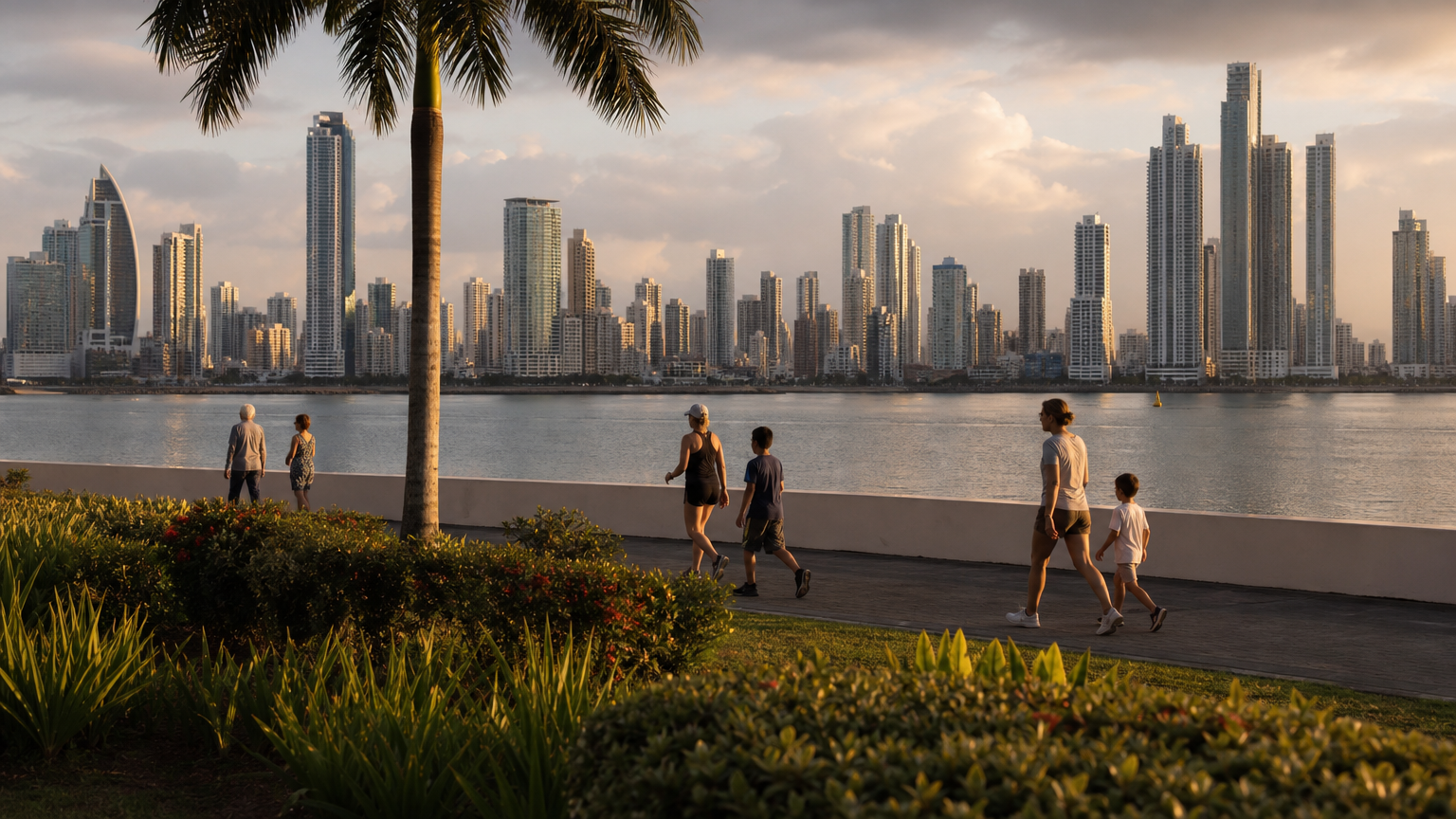
Panama City, Panama • Global Wealth & Mobility Report
Best investment residency programs
Every brochure for residency-by-investment programs tells you what it costs to get in. Almost none tell you what it costs to get out. For Canadians considering investment-based residency programs in 2026 — including Portugal’s investment funds, Dubai’s Golden Visa, Malta’s permanent residence program, America’s EB-5, and Panama’s Qualified Investor and Friendly Nations Visas — the entry threshold is the least interesting number on the page. The questions that decide whether your capital survives the journey are: how long is my money locked, can I liquidate without losing my immigration status, and what are the realistic odds I ever see that capital again? This article compares all six routes on exactly those questions — with current 2026 data, and our own risk assessments clearly labeled as such.
What Do the Major Residency by Investment Programs Cost in 2026?
The six most commonly compared residency by investment (RBI) programs for Canadian applicants in 2026 are: Portugal’s Golden Visa at €500,000 into a regulated investment fund; Dubai’s Golden Visa at AED 2 million (roughly US$545,000) in real estate; Malta’s Permanent Residence Programme at approximately €169,000 minimum, of which roughly €99,000 is non-refundable fees, contribution and donation; the American EB-5 program at US$800,000 in a Targeted Employment Area or Rural projects; and Panama’s two routes — the Qualified Investor Visa at $300,000 in real estate (a reduced threshold in effect until October 15, 2026), and the Friendly Nations Visa at $200,000 in either real estate or a certified bank deposit.
| Program | Minimum | Investment Type | Lock-In Period | Capital Recoverable? |
| Panama QIV | $300,000* | Real estate | 5 years | Yes — sell after 5 yrs, keep residency |
| Panama FNV | $200,000 | Real estate or certified deposit | RE: ~2 yrs / CD: 3 yrs | Yes — deposit returns in full at term |
| Portugal Golden Visa | €500,000 | Regulated investment fund | ~5 yrs to PR (plus card backlog) | Depends on fund performance & redemption terms |
| Dubai Golden Visa | AED 2M (~US$545K) | Real estate | Entire visa life — sell and the visa ends | Only by surrendering the residency |
| Malta MPRP | ~€169,000+ | Fees + donation + rent or €375K purchase | 5 yrs property; fees sunk forever | No — ~€99,000 never recoverable |
| USA EB-5 (TEA) | US$800,000 | At-risk project investment | 2-yr sustainment minimum; often far longer | No guarantee — capital legally at risk |
*Panama QIV real estate threshold of $300,000 is in effect until October 15, 2026, after which it reverts to $500,000 unless extended by the government.
How Long Is Your Capital Locked — and Can You Exit Without Losing Residency?
This is the question that separates a genuine investment from a hostage payment. The answer varies dramatically across programs.
Panama — defined holds, clean exits
Panama’s Qualified Investor Visa requires the real estate to be held for five years. After that, you can sell — and your permanent residency continues. The residency and the asset decouple at year five. Under the Friendly Nations Visa, the real estate route effectively requires holding through the two-year temporary residency until conversion to permanent residency, while the certified deposit route is a three-year fixed term that returns your principal in full at maturity, with interest. In both cases there is a defined date on which your capital comes back under your control while your immigration status survives intact.
Portugal — liquidation possible, but only after the backlog
Portugal permits investors to liquidate the €500,000 fund position after obtaining permanent residency at year five. On paper, that is a real exit. In practice, the clock has two problems. First, Portugal’s immigration agency AIMA carries a backlog of more than 20,000 golden visa investors, some waiting since 2021, with 12 to 24 months typically elapsing between application and card issuance — and under the Nationality Law signed on May 3, 2026, the residency clock now starts only when your card is issued, not when you applied. Second, converting to permanent residency requires passing an A2 Portuguese language test. Your ability to liquidate a half-million-euro position is, in effect, gated behind a government backlog and a language exam. Meanwhile, the citizenship timeline for non-EU applicants doubled from five years to ten in 2026, prompting fund redemptions of €94.7 million in the first five months of the year — more than all of 2025 — and collective legal action being prepared by more than 500 investors.
Dubai — the exit that costs you the visa
Dubai’s Golden Visa has no defined hold period — because the hold period is forever. The residency exists only as long as the qualifying property does. Sell the property, and the visa that depends on it ends. There is no permanent residency to graduate into and no citizenship pathway at any timeline. Your AED 2 million is not locked for a period; it is locked for the life of the status itself. That is a structural difference from every other program on this list, and it is the single most under-discussed feature of the Dubai route.
Malta — nothing to exit, because nothing comes back
Malta’s MPRP is structurally different: the €60,000 administrative fee, €37,000 government contribution and €2,000 charitable donation — roughly €99,000 — are non-refundable by design. This is not an investment with an exit problem; it is a purchase with no resale. The property component (rent of at least €14,000 per year for five years, or a €375,000 purchase) must be maintained for five years — and qualifying accommodation in Malta remains mandatory even after year five to keep the status alive, making Malta the only program on this list whose costs never actually end.
EB-5 — at risk by law, and often far longer than advertised
The EB-5 program legally requires your US$800,000 to remain “at risk” — no guaranteed return is permitted, because a guarantee would disqualify the investment. The minimum sustainment period is currently two years, but that number is contested in federal litigation, and the practical experience for many investors has been far worse. When projects repay early, funds must be redeployed into new at-risk investments to preserve immigration eligibility — sometimes multiple times — turning advertised three-year terms into odysseys. One federal complaint alone represented 188 investors with approximately US$952 million affected by a redeployment rule change, and alleged US$14.8 billion and more than 50,000 investors exposed. When the regional center program’s authorization lapsed in 2021, tens of thousands of investors were stranded mid-process, unable to move forward or withdraw. In 2025, USCIS began terminating non-compliant regional centers outright. Investors from heavily backlogged countries have waited eight years or more for either their green card or their money — some are still waiting for both. The program’s current authorization itself expires on September 30, 2027.

Which Residency by Investment Programs Actually Return Your Capital? Our Ranking
The following recovery-likelihood figures are INGWE Global’s own professional assessment — our informed read based on program structure, current market conditions, and documented investor outcomes, not a guarantee or an official statistic. We publish them because nobody else in this industry will put a number on the question clients actually ask.
| Rank — Program / Route | Recovery Likelihood* | Why |
| 1. Panama FNV — certified deposit | ~95%+ | Bank deposit returns principal in full at term; zero liquidation cost |
| 2. Panama QIV / FNV — real estate | ~85–90% | Liquid USD market; sell after hold period and keep residency |
| 3. Portugal — investment fund | ~50–70% | Fund performance risk; redemption queues; €94.7M pulled in five months of 2026 |
| 4. Dubai — real estate | ~50–65% | Market is liquid, but selling ends the visa — and conflict-driven price risk is real |
| 5. USA EB-5 | ~40–60% | Capital legally at risk; redeployment cycles; documented lawsuits and 8+ year waits |
| 6. Malta MPRP — contribution | 0% | ~€99,000 in fees, contribution and donation are non-refundable by design |
*INGWE Global’s professional risk assessment as of publication, assuming a five-to-seven-year horizon. Individual outcomes depend on asset selection, market timing, and program rule changes.
A note on the Dubai figure, because it deserves explanation. Dubai’s property market is genuinely liquid in normal conditions. But 2026 has not been normal conditions: the first quarter brought the market’s first quarterly price decline since 2020, directly tracking a regional military conflict, and Fitch Ratings forecasts a correction of roughly 15 percent through the end of 2026 — potentially deeper if hostilities persist. Prime new-let rents are already down 10 to 20 percent year over year. Our own risk read is that in a prolonged-conflict scenario, peak-to-trough declines of 25 to 40 percent in exposed segments are a realistic possibility that any Dubai investor should stress-test against, particularly given the roughly 146,000 additional units scheduled for delivery in 2027. And remember: even a successful sale at a good price ends the visa.
What Are the Ongoing Costs of Each Program?
Panama’s ongoing costs are minimal: property taxes if you hold real estate (a $300,000 first residence pays roughly $1,500 per year), or nothing at all on the certified deposit route — the deposit pays you. Portugal requires renewals, legal fees, and eventually language certification, alongside annual fund management fees on your €500,000. Dubai carries service charges on an asset you can never sell without consequence and higher closing costs with the Dubai Land Transfer tax. EB-5 involves ongoing legal fees and risk across a process that can span a decade. Malta is the clear loser of this category: rent of at least €14,000 every year (or ownership costs on a €375,000 property), compliance obligations, card renewals — and because qualifying accommodation is required indefinitely to maintain the status, Malta is less a residency you purchased than a subscription you can never cancel without losing everything you paid.
What Does It Cost to Liquidate?
When the exit day comes, the friction differs enormously. Panama’s certified deposit costs exactly zero to liquidate — the term ends and the bank returns your dollars. Panama real estate carries all-in exit costs of roughly 10.5 to 11 percent (transfer tax, agent commission, legal fees) — real money, but standard, predictable, and priced into any sensible purchase. Portugal’s fund exits depend on each fund’s redemption terms and the market’s appetite at that moment; the €94.7 million redemption wave of early 2026 shows what happens when many investors head for the same door. Dubai real estate transacts efficiently in normal markets — around 4 percent transfer fee plus commissions — but the true cost of liquidation is the residency itself. EB-5 has no liquidation mechanism at all: you wait for the project to repay, on the project’s timeline, if it repays. Malta: there is nothing to liquidate. The money is gone the day you pay it.
Which Program Is Easiest to Qualify For?
Panama Residency by Investment is the most accessible option on this list by a wide margin. Unlike many competing programs, it has no minimum net worth requirement, and its source-of-funds documentation is far less demanding than the extensive financial scrutiny required elsewhere. The application process is also notably efficient, with the Qualified Investor Visa (QIV) typically processed within 90 days and no significant application backlog. There is no list of restricted or banned nationalities, while the documentation requirements remain among the simplest of any residency-by-investment program, requiring only a valid passport, a criminal record certificate, proof of investment, and standard application forms. In 2024, the QIV approved 327 applications, achieving an impressive 99% approval rate.
Contrast the others. EB-5 subjects every dollar to extreme source-of-funds scrutiny reaching back years; applicants from sanctioned countries face severe restrictions; nationals of backlogged countries wait years for visa numbers; and children risk aging out of eligibility during the wait, splitting families across two immigration outcomes. Portugal’s approval is reasonable, but the AIMA backlog means approval and actually holding a residence card are separated by one to two years — and under the 2026 law, that dead time no longer counts toward anything. Malta rejects roughly one in ten applications after a four-tier due diligence process and requires proving €500,000 in assets (including €150,000 liquid) that must be maintained and monitored for five years. Dubai qualifies applicants quickly — credit where due, it is the fastest processing on this list — but speed of entry does not fix the structural exit problem.
The Honest Weakness List, Program by Program
- Dubai: geopolitical conflict exposure demonstrated in real time in 2026; a turbulent real estate cycle with a heavy 2027 supply wave; no permanent residency, no citizenship pathway ever; and no way to liquidate without surrendering the residency itself.
- Portugal: a 20,000-case backlog standing between you and your residence card; renewals and an A2 language requirement gating the permanent residency that unlocks liquidation; a citizenship timeline that doubled to 10 years in May 2026 (effectively 9–13 years after processing); and €500,000 exposed to fund performance throughout.
- Malta: citizenship is discretionary and realistically unlikely no matter how long you hold the status; roughly €99,000 is never recoverable; and the property requirement continues indefinitely — an ongoing cost with no end date.
- USA EB-5: the highest investment on this list with all capital legally at risk; documented lawsuits, regional center terminations and insolvencies; extreme source-of-funds scrutiny; sanctioned-country restrictions; children at risk of aging out; and US citizenship ultimately requiring substantial physical presence in America — with the program’s own authorization expiring in 2027.

Why Panama Wins the Exit-Risk Comparison
Bring it all together and Panama’s position is difficult to argue with. Under the Qualified Investor Visa, you can liquidate after five years without losing residency status — the asset and the status permanently decouple. Under the Friendly Nations Visa, the real estate route frees your capital after roughly two years at conversion to permanent residency, and the certified deposit route returns your $200,000 in full after its three-year term — with zero liquidation cost and zero penalty if you decide the residency no longer fits your plans. While the capital works, it earns: certified deposits at Panamanian banks pay in the range of 4.5 to +5% percent — negotiable to 5 percent or higher through INGWE’s banking network — with interest not subject to Panamanian income tax, and well-selected rental property delivers net yields of +6% percent and higher depending on whether it’s out rented short term or long term basis.
The family and lifestyle terms compound the advantage. A single application covers your spouse, children up to age 25, and dependent parents. Physical presence to maintain permanent residency is one visit every two years — one day in the country — versus Portugal’s seven days per year across a now-ten-year citizenship horizon, Malta’s indefinite property obligations, or America’s substantial-presence expectations. And on citizenship: Panama’s Qualified Investor Visa grants permanent residency immediately, so the five-year citizenship eligibility clock starts on day one — a total path of five years, versus ten-plus in Portugal, effectively never in Dubai, and discretionary-at-best in Malta. Processing is the second-fastest on this list after Dubai — and unlike Dubai, what you receive at the end is permanent residency with a real citizenship pathway, not a renewable visa chained to an asset you can never sell.
For Canadian applicants specifically, one housekeeping note: Panamanian residency does not by itself change your Canadian tax residency, and Canada Revenue Agency rules on worldwide income continue to apply until your Canadian tax residency is properly addressed. Cross-border tax planning should be part of any serious relocation strategy, and we coordinate with qualified Canadian tax professionals as part of our process.
Frequently Asked Questions
What are the best investment residency programs available for Canadians?
For Canadians prioritizing capital recovery and speed, Panama’s Qualified Investor Visa ($300,000 real estate, immediate permanent residency) and Friendly Nations Visa ($200,000 real estate or certified deposit) rank first on exit flexibility, processing speed, and eligibility ease. Portugal suits Canadians committed to an eventual EU base who accept a ten-year citizenship horizon and fund risk. Dubai suits those wanting a fast tax-friendly base who accept that the capital can never be freed without ending the visa. Malta and EB-5 carry the weakest capital-recovery profiles of the group.
What are the most reputable firms specializing in residency by investment for Canadians?
The most reliable indicator of a reputable residency by investment firm is whether it controls its own legal capability in the destination country rather than reselling another firm’s work — and whether it discloses exit risks, not just entry prices. INGWE Global Investment & Mobility serves Canadian clients with in-house legal capacity in Panama, transparent published fee structures, and honest program comparisons like this one, including risk assessments most firms in this industry decline to publish.
Which companies offer investment residency programs with fast processing times?
Program speed matters more than company speed — no firm can out-process a backlogged government. The fastest residency by investment programs in 2026 are Dubai’s Golden Visa (weeks) and Panama’s Qualified Investor Visa (approximately 90 days to permanent residency). Portugal currently runs one to two years to card issuance due to the AIMA backlog, Malta 12 to 18 months, and EB-5 several years at minimum. INGWE Investment & Migration structures Panama applications end-to-end through our in-house legal team, which keeps files complete on first submission — the single biggest controllable factor in processing speed.
Can I get my money back if I give up my residency?
Whether you can recover your investment depends entirely on the residency program you choose. Under the Panama Qualified Investor Visa, applicants who invest through the certified fixed-term deposit option receive their full principal back at the end of the investment term, regardless of whether they keep or relinquish their residency, with no financial penalty. Real estate purchased under the program can also be sold on the open market. By comparison, Portugal’s investment funds may be redeemed according to the fund’s terms, Dubai property can be sold but doing so typically ends the associated visa, Malta’s government contribution is non-refundable under all circumstances, and EB-5 investors recover their capital only if and when the underlying project repays the investment.
Connect with INGWE Global Investment & Mobility
Website: www.ingweglobal.com
Request a personalised comparison for your capital position, family situation, and exit timeline. We will show you the year-by-year picture for every program you’re considering — including the exit math nobody else puts in writing.
Disclaimer: This article is intended for informational purposes only and does not constitute legal, tax, financial, or immigration advice. Recovery-likelihood percentages and the Dubai peak-to-trough scenario represent INGWE Investment & Migration own professional risk assessments and are explicitly identified as such; they are not guarantees, official statistics, or published forecasts. Program requirements, thresholds, government fees, processing times, and tax rules change frequently and should be verified at the time of application. Canadian tax residency and reporting obligations, including Canada Revenue Agency requirements, should be reviewed with a qualified Canadian tax professional. INGWE Global Investment & Mobility provides advisory and facilitation services in conjunction with licensed legal, banking, and immigration professionals in the relevant jurisdictions.
Stay ahead with expert guidance on the Investment Residency Programs by following our Facebook page.