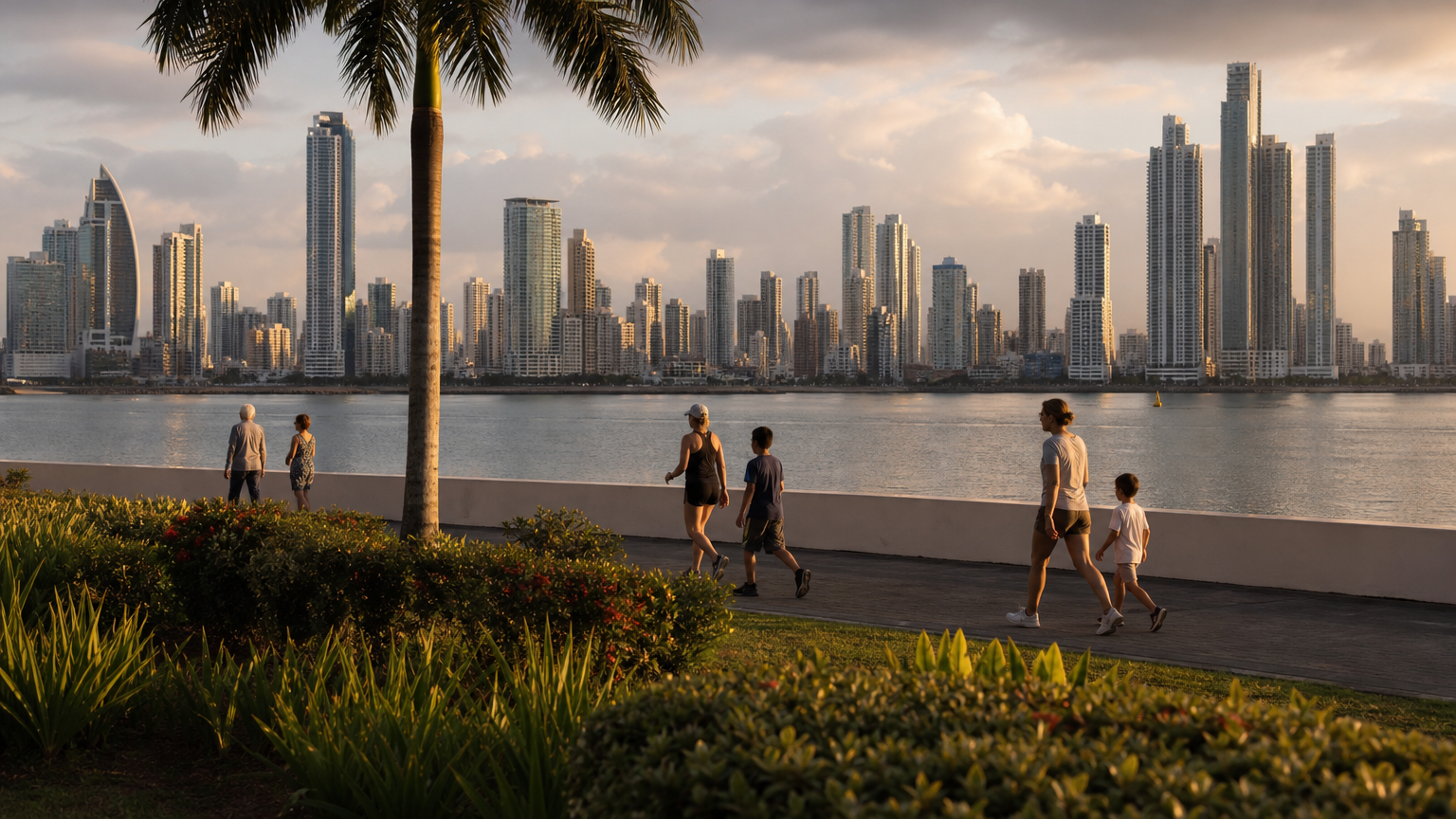
Healthcare Abroad Without the US Price Tag: 5 Questions to Ask Before You Move
Healthcare abroad can give a foreigner access to some of the best medical care in the world, provided the right questions are asked before the move rather than after. The most common mistake is assuming that your home coverage follows you across the border, or that Canada, the country next door, is the safe answer. The figures below show why neither assumption holds. This guide then walks through five countries that let a resident opt into the public system, and one alternative in Panama that takes the opposite approach and still competes on technology, access, and price.
It is written for three kinds of readers. The first is a 58-year-old who retired early and faces the gap before Medicare begins. The second is a 66-year-old paying Part B premiums every month for coverage that stops at the border. The third is a family of four writing a mortgage-sized check to an insurance company just to keep a doctor’s phone number on file.
The structure follows five questions, because the people who get healthcare abroad right ask them in order. Will my home coverage follow me? Can I join the public system, and how? What does it really cost, premiums included? Is the care good where I will actually live? How much time do I have to spend there to keep my residency? Answer those five honestly and the country picks itself.
Key takeaways
- Medicare is a domestic program. It usually does not cover care outside the US, and dropping Part B can lead to a 10% penalty for every full 12-month period without it, for as long as you hold it.
- Moving to Canada is not a shortcut. In 2025, the median wait from a family doctor’s referral to treatment was 28.6 weeks, about 200 days.
- Italy, Portugal, Spain, France, and Cyprus let foreign residents opt into public healthcare, each with its own cost, waiting period, and paperwork.
- Budget for two numbers: the public contribution and the private cover that bridges the gap until the public system accepts you.
- Residency presence rules can matter as much as premiums for anyone keeping a business, a home, or family in North America.
Question 1: Will Your Home Coverage Follow You Across the Border?
If You Are American
For Americans, the short answer is no. Medicare’s own guidance on travel outside the US states that it “usually doesn’t cover health care while you’re traveling outside the U.S.” There are narrow exceptions, such as a foreign hospital that is closer to your home than the nearest US hospital that can treat you. Even then, in the program’s words, “you pay all of the costs, in most cases.” In plain English, Medicare is a domestic product, and it stays domestic. Medicare abroad is the exception, not a plan.
For readers who have never dealt with Medicare, here is the one-minute version. Medicare is the US federal health insurance program, and it generally starts at 65. It comes in parts, and two of them matter for a move. Part A is hospital insurance: it pays for a stay in the hospital, time in a skilled nursing facility after a hospital stay, and hospice care. Part B is medical insurance: it pays for doctors’ visits, outpatient care, lab tests, and preventive screenings.
Two details are easy to miss. The first concerns Part A. Most people pay no monthly premium for it, because they or a spouse paid Medicare payroll taxes for at least 10 years of work. Since it is free, cancelling it saves you nothing. Keeping it means that if you fly home for surgery or an emergency, hospital cover is waiting for you.
The second concerns Part B. It carries a monthly premium, $202.90 for most people in 2026, taken out of your Social Security check or billed to you, whether you see a doctor or not. Because it pays nothing abroad, cancelling it on the way out is tempting. However, if you sign up for Part B later, after the seven-month window around your 65th birthday, you can only enroll between January 1 and March 31 each year. Coverage starts the month after you sign up. You also pay a 10% penalty for every full 12-month period you could have had it, for as long as you hold it. Five years without Part B means a premium 50% higher, for life.
If you expect to retire back in the US, or to spend real time there, keeping Part B protects you. If you are certain you will never return, you can save the premium. Either way, make the decision about Medicare abroad with your eyes open, and speak to a Medicare adviser before you cancel anything.
If you are under 65, there is no Medicare at all. That is the early-retirement gap, and it is exactly why many people start looking at what a second residency can do.
The Biggest Mistake: Moving North for Healthcare
Many Americans assume they can simply move to Canada because it has free healthcare. That assumption is far from the truth, and the Fraser Institute’s 2025 wait-times study puts numbers on it. In 2025, the median Canadian waited 15.3 weeks to see a specialist after a referral from the family doctor, and then another 13.3 weeks for the treatment itself. That is 28.6 weeks, about 200 days. The Fraser Institute’s own benchmark for a clinically reasonable wait is 8.8 weeks.
To put 200 days in context: if you were referred on the day you conceived a baby, you would be 28 weeks pregnant, at the doorstep of the third trimester, before you were treated. By comparison, a Panama Pensionado application takes 3.5 to 5.5 months from filing to approval. In other words, you can hold permanent residency in a second country, and be sitting in a doctor’s office there, before a Canadian referral becomes a procedure.
Canadians are also voting with their feet. An estimated 105,529 Canadians were treated outside the country in 2025, up 66% in a decade. Ontario alone sent 51,538 patients, more than enough to fill a major league ballpark. British Columbia sent 25,698 and Alberta 13,919. As the Fraser Institute’s own health policy director put it, these are “Canadians paying twice for health care.”
After years of working with Canadians, INGWE’s view is that the system is built to react rather than to prevent. Patients are seen when they are sick, rarely while they are well, and quality has slipped over the last ten years. If you are healthy, the “free” care may serve you well enough. If something is developing, it makes sense to act before it becomes worse, because the wait does not shorten for a worried patient.
Question 2: Can You Join the Public System? Five Countries That Let You Opt In
Opting in means the government lets a foreign resident buy into its public health system, usually for a monthly or annual contribution, instead of leaving you to private insurance alone. In plain English, you pay a fixed amount and use the same public doctors and hospitals as the locals. For all five countries below, the rules described apply to investors, pensioners, and the self-employed, not students.
Malta is not on this list for a specific reason. A non-EU resident under its residence programmes has to hold qualifying private health insurance. There is no public system to buy into, and private cover is the entry fee. Malta is an attractive island, but it is the wrong fit for this particular question.
Italy
Italy lets foreign residents with a valid permit voluntarily enroll in the Servizio Sanitario Nazionale, the National Health Service. The contribution follows your household income: 7.5% of income up to €20,658.28, plus 4% of the portion above that, up to €51,645.69. The local health authority’s guidance adds that “in ogni caso l’importo non potrà essere inferiore” to €2,000, which means the amount is never less than €2,000 a year. Enrollment runs by calendar year, from January 1 to December 31, with no partial periods and no retroactive effect.
Portugal
Portugal’s route is simple, and also easy to misread. The government’s own service page says that for foreigners, “o número é atribuído na primeira vez que se dirijam a uma unidade de saúde pública,” meaning the number is assigned the first time you go to a public health unit. The same page includes a line that many guides skip: “A atribuição do número de utente de saúde não garante a cobertura das despesas dos cuidados de saúde pelo SNS.” In plain English, having the number does not guarantee that the National Health Service pays for your care. Ask what you are covered for before you need it.
Spain
Spain publishes the clearest terms of the five. Its special health agreement, the convenio especial, puts economically inactive foreign residents into the national health system for a flat fee: a “cuota mensual de 60 euros” if you are under 65, and a “cuota mensual de 157 euros” if you are 65 or older. There are no copayments for covered care. The conditions are “acreditar la residencia efectiva en España durante un período continuado mínimo de un año,” meaning one year of continuous effective residence; registration on a town’s municipal register, the padrón; and no other public coverage. One detail deserves attention: outpatient prescription drugs are paid 100% by you. Spain’s Non-Lucrative Visa requires private cover anyway, which is how most people bridge that first year.
France
In France, opting in means exactly that: you have to apply. Your way in is the long-stay visa for visitors. It requires proof of sufficient resources of €1,426 a month per applicant, about €17,115 a year, from a pension, rental income, a bank account, or family. It also requires accommodation in France for the start of your stay and valid French health insurance with minimum coverage of €30,000. Travel insurance does not count. You cannot work in France on this visa, and each family member files an individual application.
The visa is a VLS-TS, a long-stay visa that doubles as a residence permit once you validate it within three months of arrival. After 5 years of continuous residence, you can apply for a 10-year residence card. The private policy is your bridge, because public coverage is neither automatic nor assumed by the French authorities. A non-European who is not working has to apply to PUMA, the Protection Universelle Maladie or Universal Health Protection scheme, “after 3 months of uninterrupted residency in France,” in the Assurance Maladie’s wording. The application needs a copy of your visa or residence permit and proof of residence, which means a local lease or a utility bill. In practice, local support helps to get the file through. It is an extra step, but it is a real door.
Cyprus
Cyprus runs GESY, its General Healthcare System. Once your residence permit is issued and you are registered with the civil registry and social insurance, you can register with GESY. Contribution rates reported for 2026 are 2.65% on pensions, rent, dividends, and interest, and 4.00% if you are self-employed.
The table below compares how healthcare abroad works for residents in each of the five opt-in countries.
| Country | How you opt in | What it costs | The catch |
|---|---|---|---|
| Italy | Voluntary enrollment in the National Health Service with a valid residence permit | 7.5% of household income up to €20,658, then 4% up to €51,646; local guidance sets a floor of €2,000 a year | Runs by calendar year, January 1 to December 31; no partial periods, no retroactive cover |
| Portugal | Register at a public health centre; your user number is assigned on your first visit | Funded by taxes, with small user fees at the point of care | The government itself says a user number does not guarantee the SNS pays for your care |
| Spain | Special health agreement (convenio especial) with your regional health service | €60 a month under 65; €157 a month at 65 or older | One year of residence first, registration on the town register, no other public cover; outpatient drugs are 100% yours |
| France | Long-stay visitor visa first, then apply to PUMA, the Universal Health Protection scheme, with your visa or permit and a local lease or utility bill | Contribution rules depend on your income type | Not automatic: French private cover of at least €30,000 for the visa, then 3 months of uninterrupted residence, then an application |
| Cyprus | Register with GESY, the General Healthcare System, after your residence permit is issued | 2.65% on pensions, rent, dividends and interest; 4% if self-employed | Permit, civil registry and social insurance steps come first and can take weeks |
Contribution amounts are those reported by government and official sources as of October 2026 and may change.
Question 3: What Does Healthcare Abroad Really Cost? Contributions, Premiums and the First-Year Gap
There are two numbers to budget. The first is the contribution to the public system. The second, and the one people forget, is the private cover that bridges you until the public system will take you. Spain asks for a year of residence. France asks for three months. Italy and Cyprus ask for permits and paperwork that can take weeks. During that window, you are paying a private premium.
Run the contribution math before you make a decision. In Italy, a household with €30,000 of income works out to roughly €1,549 on the first slice plus about €374 on the rest, €1,923 in total. That is below the €2,000 floor, so the cost is about €167 a month. At €40,000, it can be around €2,323 a year, about €194 a month. In Cyprus, €3,000 a month of pension and dividend income can mean about €80 a month at 2.65%. In Spain, a couple under 65 pays €120 a month. These figures are conditional on your income type and household, so treat them as ranges, not promises.
Premiums are the second half of the budget. The cost of the private bridge, and of private-only life in Panama, depends on your age, your health history, and the plan. The comparison below shows monthly premiums for the whole household.
| Who you are | Panama private premium (monthly) | Typical US premium (monthly) |
|---|---|---|
| Single adult, age 45 | About $100 to $200 on a local plan; about $180 to $350 on an international plan | About $650 to $750 on a benchmark plan, before subsidies |
| Couple, age 60 | About $350 to $550 on a local plan; international plans usually cost more at this age | About $2,500 to $2,800 for the two of you, before subsidies |
| Family of four | About $300 to $550 on a local plan; about $400 to $900 on an international plan | About $2,000 to $2,300 on the individual market; about $2,250 on an average employer plan, of which the employee pays about $570 |
Estimates for 2026, in US dollars. US figures: the Kaiser Family Foundation reports a national average benchmark premium of $625 a month for a 40-year-old on the individual market, scaled here by the federal age-rating curve for ages 45 and 60 and for children; the employer-plan figures are its 2025 survey averages ($26,993 a year in total for family cover, $6,850 paid by the worker). Panama figures are ranges from published local and international plan rates; real quotes depend on your age, health history and deductible.
At every household size, private cover in Panama costs roughly 15% to 50% of the US figure, depending on whether you choose a local plan or a broader international one. A family of four can pay around $2,250 a month in the US for an average employer plan, and most of that cost is invisible because the employer pays the bulk of it.
Two caveats apply. A US premium comes with its own deductible, and Panama plans differ in networks, age limits, and pre-existing condition rules, so the premium is not the whole price. Local plans are the cheapest, but they often stop accepting new members somewhere between the mid-50s and the mid-60s, and they can exclude or delay cover for pre-existing conditions. For that reason, the right plan is chosen with a quote in hand rather than from a table.
Question 4: Is the Care Good Where You Will Actually Live?
The quality of healthcare abroad depends on the neighborhood and the city more than on the country. Every one of these nations has excellent hospitals in its large cities and thin coverage in the hills, and the retirees who get burned are usually the ones who chose a village for the view. Before you sign a lease, answer four questions:
- How far is the nearest hospital with a full emergency department?
- Do the doctors and specialists you would actually see speak your language?
- Are the medications you take on the local formulary?
- Where does the public system send you for what it cannot treat?
Without those answers, you have not yet chosen a town. You have chosen a photograph.
Question 5: How Much Time Do You Have to Spend There?
This is the question that quietly ends many Plan Bs. A public system you can opt into is only valuable if the residency behind it fits your life. For a family that still has a business, a home, or grandchildren in North America, the time requirement can matter more than the premium.
| Country | Time you need to spend there | What that means for a Plan B |
|---|---|---|
| Italy | Residency permit required | A lifestyle move, not a base you visit |
| Portugal | Golden Visa has the most flexible rules | Temporary permit first, permanent status later |
| Spain | More than 183 days a year to renew the Non-Lucrative Visa | Half your year, every year |
| France | Real residence: validate your long-stay visa within 3 months of arrival, and 5 years of continuous residence for a 10-year card | You must actually live there, and you cannot work |
| Cyprus | Habitual residence | Permit steps first, then registration |
| Panama | One day every two years once you hold permanent residency | Live anywhere, keep Panama as your base |
Presence rules differ by permit type and may change.
The Wild Card: How Panama Approaches Healthcare Abroad Differently
Panama breaks the pattern of this list on purpose. It does not offer a public health system for foreigners to opt into. What Panama offers instead is access: American-style private care with the latest technology, up-to-date medications, and modern imaging such as the latest MRI machines. When you pay out of pocket, that care costs about half the US price, or less. If you carry private insurance, the premiums are a fraction of what you would pay in the US.
Geography strengthens the case. Panama is a 3 to 4 hour flight from many US cities, so family can visit you, and you can reach home quickly if you need to.
Clients also ask about stem cell and peptide treatments, which are offered in Panama under the supervision of licensed medical doctors. INGWE’s founder, Reza Motalebpour, and his family have used them. They are not medically proven in the conventional sense that regulators use, and people look for them anyway. Reza is not a doctor, and INGWE does not sell treatments. Supervision by a licensed physician is the only acceptable way to approach them. Before any decision, ask for a doctor’s advice, the regulatory status of the treatment, and what your insurance will and will not cover.
How a North American Gets Residency in Panama
The most affordable route is the Pensionado visa, for anyone with a lifetime pension or annuity of $1,000 a month, with no minimum age. It grants permanent residency from day one, with no renewals, and requires one day in Panama every two years. For those without a pension, the Friendly Nations Visa is open to citizens of 52 countries, including Ecuador, the UK, EU countries, the United States, and Canada. It can cost around $1,950 to set up a company through the job offer route, or $200,000 in real estate or a certified deposit.
No Panama work permit comes with the Pensionado. That restriction applies only to Panama’s local labor force. It does not prevent remote work for a foreign employer or running your own company.
Tax belongs in the same conversation. Panama does not tax income earned outside the country, but income from a Panama source, such as rent from Panama property, is taxed in Panama. The US taxes its citizens wherever they live, while Canada taxes its residents on worldwide income.
Hidden Details About Healthcare Abroad That Cost People Thousands
- Opting in takes a deliberate application. France wants an application and a lease. Spain wants a year. Nobody enrolls you for free.
- Keep Medicare Part A, and think hard before dropping Part B. Part A is hospital insurance and normally costs nothing, so cancelling it saves you nothing. Part B is the doctor and outpatient cover with a monthly premium, and rejoining later means waiting for the January to March window and paying a permanent 10% penalty for every full year you went without it.
- Canadians should not count on their government healthcare to cover them outside Canada after relocating. Keeping Ontario’s OHIP requires 153 days a year in Ontario, which defeats the point of a low-presence Plan B.
- Spain’s convenio especial covers care, not prescriptions. Outpatient drugs are 100% on you.
- Italy’s contribution is by calendar year. Enroll in December and you have paid for a month of a twelve-month rule, with nothing back.
- A Portuguese user number does not mean full coverage. It covers basic medical needs, so ask what the SNS will actually pay for.
- Self-employed people pay more in Cyprus: 4.00% against 2.65% for pension and investment income.
- Buy international cover before you leave, to cover the gap until your government healthcare abroad takes over. Pre-existing conditions are much harder to insure after you have moved than before.
Our Professional View: Getting Healthcare Abroad Right
Good healthcare abroad is the result of decisions made in the right order. Start by knowing what your home coverage actually does outside your border. Then pick a system you can opt into, or a market where private care is affordable enough to carry on your own. Finally, match the time the residency demands to the life you actually want.
For families still waiting 200 days for a specialist back home, the people who left did not simply get lucky. They asked five questions before they moved, and they asked them in order.
The people who get healthcare abroad right ask five questions, and they ask them in order. Will my coverage follow me? Can I join the public system? What does it really cost? Is the care good where I will live? How much time do I have to spend there? Answer those honestly and the country picks itself.
Reza Motalebpour, INGWE Global Investment & Mobility
Frequently Asked Questions
Does Medicare cover healthcare abroad?
Usually not. Medicare’s own guidance says it usually doesn’t cover health care while you’re traveling outside the US, and even under its narrow exceptions you pay all of the costs in most cases. Anyone relying on Medicare abroad should arrange other cover before leaving.
Should I cancel Medicare Part B if I move overseas?
Only if you are certain you will never return to the US. Part B pays nothing abroad and costs $202.90 a month for most people in 2026, but signing up again later means enrolling only between January 1 and March 31 and paying a 10% penalty for every full 12-month period without it, for as long as you hold it. Speak to a Medicare adviser before cancelling.
Which countries let foreign residents join their public healthcare system?
Italy, Portugal, Spain, France, and Cyprus all let foreign residents opt in, each on its own terms. Italy charges an income-based contribution with a €2,000 annual floor, Spain charges €60 a month under 65 and €157 at 65 or older, France requires a PUMA application after 3 months of uninterrupted residence, Cyprus charges 2.65% on pensions and investment income, and Portugal assigns a user number at your first visit to a public health unit.
Is moving to Canada a good way for Americans to get cheaper healthcare?
It carries long waits. In 2025, the median Canadian waited 28.6 weeks, about 200 days, from a family doctor’s referral to treatment, against the Fraser Institute’s benchmark of 8.8 weeks. An estimated 105,529 Canadians were treated outside the country that year.
How much does private health insurance cost in Panama compared with the US?
At every household size, private cover in Panama costs roughly 15% to 50% of the US figure. A couple aged 60 can pay about $350 to $550 a month on a local Panama plan, against about $2,500 to $2,800 in the US before subsidies. Deductibles, networks, and pre-existing condition rules also affect the real price.
Can foreign residents use public healthcare in Panama?
No. Panama does not offer foreigners a public health system to opt into. Residents use private care, which costs about half the US price or less when paid out of pocket, and the Pensionado visa requires only one day in Panama every two years once you hold permanent residency.
How long before public healthcare abroad covers a new resident?
It depends on the country. Spain’s convenio especial requires one year of continuous residence, France requires 3 months of uninterrupted residence before a PUMA application, and Italy and Cyprus require permits and registrations that can take weeks. Private international cover bridges that gap.
Connect With INGWE Global Investment & Mobility
Healthcare is one part of a relocation plan that also covers residency, tax, and investment. INGWE’s in-house legal team in Panama handles this kind of structure every day. For 9 years, INGWE has specialized in global mobility and cross-border investment solutions. The team, licensed in Panama and covering both taxation and immigration under one roof, works with every nationality on earth, not just a shortlist of eligible countries.
INGWE specializes in the programs of the American continent: Canada, EB-5 in the USA, Panama, Mexico, Belize, the Dominican Republic, Brazil, and now Argentina’s citizenship by investment. The firm is also a licensed processor for the Nauru (Naoero) Citizenship by Investment program. Through its network of licensed specialists, it structures residency, tax, and real estate solutions across the EU, including Portugal, Greece, and Cyprus. If Panama is not the final answer for your situation, the team already knows where to look next.
Whether your path is zero capital, a genuine Plan B built on residency optionality, or a full cross-border tax and investment strategy backed by tangible real estate, INGWE builds it end to end as one coordinated file across global real estate, residency, and citizenship. Your tax planning is structured first, by the in-house legal team and tax specialists, before a single dollar is invested in any jurisdiction.
To find out which path fits your goals, in Panama or elsewhere in the INGWE network, book a private consultation before you file anything. The team will assess your specific situation, map your fastest route, and build your plan properly, the first time.
Disclaimer: This article is intended for informational purposes only and does not constitute legal, tax, financial, immigration, or medical advice. It reflects publicly available information as of October 2026. Healthcare contributions, premiums, eligibility rules and residency requirements change and vary by permit type and personal circumstances; confirm each with the relevant government authority. Stem cell, peptide and other treatments mentioned are not necessarily approved or proven by medical regulators, may not be covered by insurance, and should be discussed with a licensed physician before any decision. Canadian residents must report specified foreign property over CAD $100,000 to the CRA (Canada Revenue Agency), and US persons must meet FBAR (Report of Foreign Bank and Financial Accounts) and FATCA (Foreign Account Tax Compliance Act) reporting where thresholds apply. Consult licensed immigration counsel and a qualified tax professional before committing funds. INGWE Global Investment & Mobility provides advisory and facilitation services in conjunction with licensed legal, tax, financial, and immigration professionals.