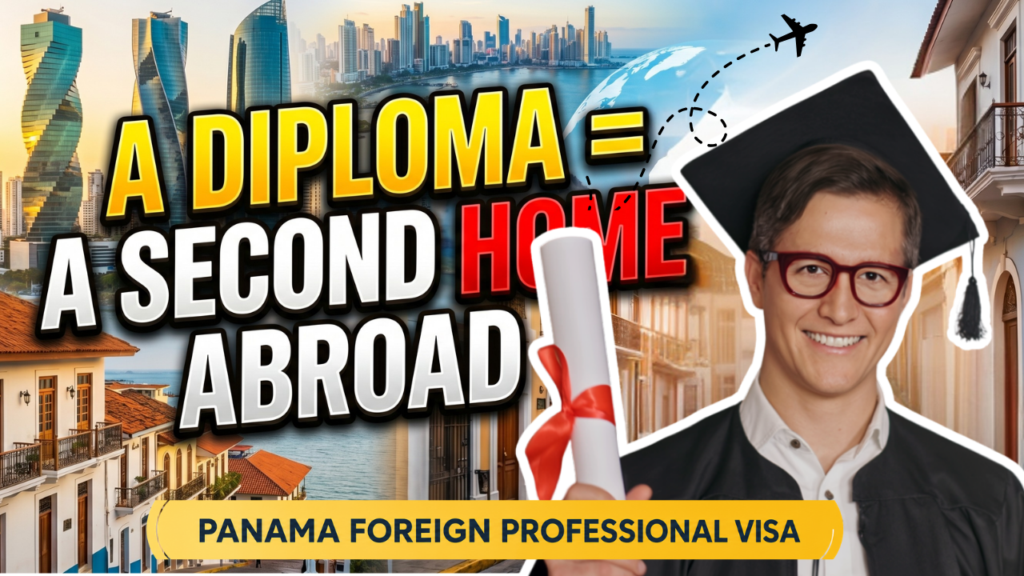
Across North America and well beyond, a growing number of professionals are quietly building an exit plan. Not from their careers, but from rising taxes, climbing living costs, and political uncertainty at home. The destinations drawing them tend to offer the same shortlist: lighter tax treatment, a stable economy, a better quality of life, and a clear legal route to stay. For degree holders, one of the most accessible of those routes is Panama residency without investment, secured through the Panama Foreign Professional Visa. The Panama Foreign Professional Visa is increasingly recognized as a viable option for many professionals seeking relocation.
Panama sits high on the shortlist. It runs a territorial tax system, uses the US dollar, and offers several residency pathways. The Foreign Professional Visa grants permanent residency in Panama on the strength of a university degree, along with the right to work. No property purchase. No pension requirement. The qualifying basis is simply your education, making the Panama Foreign Professional Visa an appealing choice for qualified individuals.
For educated professionals, freelancers, and remote workers building a long-term base, the appeal is the low barrier to entry. What the visa asks for is a recognized university degree and the willingness to move through a structured, multi-stage process.
This guide explains how the Panama Foreign Professional Visa works in 2026: eligibility, the three stages from degree validation to permanent residency, the work permit, full timelines and costs, and the tax and compliance details most articles leave out. Understanding these factors is essential for applicants of the Panama Foreign Professional Visa.
What Is the Panama Foreign Professional Visa?
The Panama Foreign Professional Visa is a residency category established under Executive Decree No. 804 of October 9, 2012. It allows a foreign national who holds a university degree to obtain permanent residency in Panama in order to practice their profession, with no investment and no pension required. This makes the Panama Foreign Professional Visa a unique opportunity for many.
It sits apart from Panama’s investment-linked routes. The Friendly Nations Visa requires a job offer, real estate, or a bank deposit. The Qualified Investor Program requires a larger capital commitment. The Pensionado Visa requires a lifetime pension. The Foreign Professional Visa requires none of these. Your qualifying basis is your education, which is what makes it one of the clearest paths to Panama residency without buying property.
Two features define its accessibility. First, nationals of any country can apply, unlike the Friendly Nations Visa, which is open only to passport holders from designated countries. Second, the qualifying degree must be in a field that is not legally reserved for Panamanian nationals. Panama maintains a list of restricted professions reserved for citizens, and a degree in one of those fields will not qualify. Since there are many nuances, INGWE can assess whether your specific profession qualifies before any filing begins.
Beyond the degree, the barrier to entry is low. The main applicant does not need to make an additional investment, and a local bank account is not required to qualify, unless you are applying with dependents. What the program rewards is education and a clean, well-prepared file.
Including Your Family
The Foreign Professional Visa allows you to include dependents in your application. Panama residency routes typically permit a spouse, dependent children, and dependent parents, and INGWE confirms the exact categories and any age limits for your situation during the consultation.
This paragraph emphasizes the advantages of the Panama Foreign Professional Visa for those looking to relocate.
One distinction applies to dependents. While the main applicant does not need a local bank account to qualify, including dependents requires demonstrating income, either through a Panamanian bank account or proof that you are working.
For dependents, the following must be provided:
-
- Proof of family relationship (duly apostilled marriage or birth certificate).
- A letter of responsibility from the main applicant.
- Proof of the main applicant’s financial solvency through a local bank reference letter showing an average balance of at least mid four figures (USD 5,000), or through an employment letter together with the Social Security (Caja de Seguro Social) pay slip, or through an income tax return showing a monthly income of USD 1,000.
- If they are minors, authorization from the other parent to carry out the process is required.
- Payment of USD 250 to the National Treasury (Tesoro Nacional), and payment of USD 800 to the National Immigration Service (Servicio Nacional de Migracion). Minors under 12 years old are exempt from this payment.
- If they are of legal age: apostilled criminal record certificate.
The Panama Foreign Professional Visa is also beneficial for those seeking to start a new life in a vibrant country.
- If they are children over 18 and under 25 years old: proof of student status.
Who the Foreign Professional Visa Suits Best
This route is well matched to internationally mobile professionals who hold a degree (Technical Superior University, Bachelor’s, Master’s, or Doctorate) and who want a long-term Panama base without locking up capital in property or a fixed deposit. It is also relevant for those who want the option to work locally or to operate as a self-employed professional in Panama.
It is less suited to applicants in a hurry. As the timeline below shows, degree validation alone can take several months, and the full path to permanent residency runs across years rather than weeks.
Foreign Professional Visa vs Friendly Nations Visa
Both routes lead to Panamanian permanent residency, and both begin with a two-year temporary stage. The difference is what qualifies you.
|
Aspect |
Foreign Professional Visa |
Friendly Nations Visa |
|
Qualifying basis |
A university degree in a non-restricted profession |
Real estate, a bank deposit, or employment |
|
Eligible nationalities |
Any country |
Around 50 designated nations |
|
Minimum investment |
None |
From USD 200,000 (real estate or deposit route) |
|
Local bank account |
Not required for the main applicant Those considering the Panama Foreign Professional Visa should be aware of its requirements and advantages. |
Required for the deposit route |
|
Initial status |
Two-year temporary residency |
Two-year temporary residency |
|
Path to permanent residency |
After the two-year period |
Convert after the two-year period |
|
Work permit |
Yes, through MITRADEL, no job offer required |
Yes, employment route needs a stamped contract |
For an eligible professional who would rather not commit capital, the Foreign Professional Visa is often the more accessible route to permanent residency in Panama. For those who do not hold a qualifying degree, or who prefer a property or deposit-based path, the Friendly Nations Visa may fit better. INGWE maps both against your profile before recommending one.
For many professionals worldwide, the Panama Foreign Professional Visa offers a smooth transition to life in Panama.
How the Process Works: Three Stages
The full process consists of degree validation (homologation) followed by two residency stages. A work permit is obtained in parallel.
Stage 1: Degree Validation (Homologation)
This is the first step. The foreign university degree must be recognized, or homologated, by the University of Panama for most fields, or by the Technological University of Panama (UTP) for technical and engineering fields.
A critical point that is often misunderstood: homologation does not grant the right to practice your profession in Panama. It validates the degree for immigration purposes only.
Typical documents for homologation include the original apostilled diploma, the apostilled academic transcript, an apostilled authenticity letter from the issuing university, the study plan or curriculum, a passport copy, the University of Panama application form, and payment of the homologation fee.
|
Step |
Responsible party |
Time |
|
Apostille the degree in the country of origin |
Applicant |
1 to 4 weeks |
|
Official Spanish translation of the degree |
Panamanian public translator |
1 to 2 weeks |
|
Apostille academic transcript |
Applicant |
1 to 2 weeks |
|
Submit homologation file to University of Panama or UTP |
Applicant or attorney |
1 day |
|
Evaluation and issuance of homologation resolution |
University of Panama or UTP |
4 to 8 months |
|
Collect homologation resolution |
Applicant or attorney |
n/a |
Stage 2: Two-Year Temporary Residency
Once the homologation resolution is in hand, the application is filed through a Panamanian lawyer. You must be physically present in Panama for the registration and biometric appointment, so this step can’t be done remotely. Plan for a short trip of about five business days.
Shortly after the application is submitted, you’re issued a temporary card carrying a multiple-entry visa. That means you don’t have to stay in Panama while the application processes over the following months. You can fly home and come and go as you please until the final card is ready.
Stage 2 documents typically include a notarized power of attorney to a Panamanian lawyer, five passport photographs, a notarized passport copy, an authenticated police record, a health certificate from a Panamanian physician (minimum three-month validity), certified checks payable to the National Treasury and to the SNM, a sworn statement of personal background, the apostilled degree, the homologation resolution, and a copy of a home-country identity document.
Applying for the Panama Foreign Professional Visa can lead to exciting new career opportunities.
With the temporary resident card, the professional may legally reside in Panama for two years. During this window, the holder applies for the MITRADEL work permit if needed, keeps their immigration status active, and notifies the SNM of any change of address. Residing in Panama full time is not required. The status stays valid as long as the holder visits Panama at least once every two years.
The Work Permit (MITRADEL)
Once the temporary resident card is issued, the professional may apply for a work permit from the Ministry of Labor and Workforce Development (MITRADEL). Under Law No. 6 of 2023, no prior job offer is required to apply, as a self-employed route is available.
The Self-Employment Option (Permit Type 6A)
Professionals who intend to work for themselves can apply for a Self-Employment Work Permit (Type 6A) rather than relying on an employment contract. To apply for a self-employed work permit, it is necessary to obtain a RUC (Tax ID) and an Operations Notice (Aviso de Operaciones). Once the Operations Notice has been processed, registration with the Municipality of Panama must be completed, along with monthly tax payments. Annually, there is an obligation to file the Municipal Declaration and the Income Tax Return.
The work permit is initially approved for 2 years, and it can then be renewed up to 3 times, with each renewal valid for 3 years.
To renew the work permit later, the holder must show a Social Security (CSS) record with nine paid contributions, or, in the case of the self-employed work permit, a sworn income tax declaration filed with the DGI.
As with renewing the work permit, advancing to permanent residency requires the applicant to show at least nine months of Social Security (CSS) contributions or a sworn income tax declaration filed with the DGI, which is exactly why the RUC and consistent monthly filings matter so much for self-employed professionals. There is also a sequencing reason to set this up early: because permanent residency in Stage 3 requires a DGI Tax Clearance Certificate (Paz y Salvo), keeping an active RUC from the start of the process ensures your tax record stays clean and ready by the time Stage 3 arrives.
Many applicants find the Panama Foreign Professional Visa to be a straightforward path to residency.
Stage 3: Permanent Residency
Before that two-year window closes, you file for definitive residency. At this stage, you refresh the standard documents to their current versions, your passport and health certificate among them, and you must also demonstrate that you have been active in the system. This is satisfied by showing either at least nine months of Social Security contributions or a sworn income tax declaration filed with Panama’s tax authority. You then add the document that ties everything together: a tax clearance certificate confirming that your tax record in Panama is in good standing. This is precisely why staying on top of your tax registration from day one matters so much.
Keep in mind that if you are not already living in Panama full time, you will again need to make two short trips, one to register at the outset, and a second near the end to collect your permanent residency card in person.
Timelines and Costs
Expect the full path, from the start of homologation to definitive permanent residency, to run approximately 36 to 48 months. Most of that is the mandatory two-year residency period rather than active processing.
|
Stage |
Estimated time |
|
Degree validation (homologation) |
4 to 8 months |
|
Document preparation and apostilles |
4 to 12 weeks |
|
Stage 2: Temporary residency (2 visits to Panama or remaining in the country) |
3 to 6 months |
|
Mandatory temporary residency period |
24 months |
|
Stage 3: Permanent residency (2 visits to Panama or remaining in the country) |
3 to 5 months |
|
Work permit (MITRADEL), parallel to Stage 2 |
2 to 4 months |
Costs below are shown in Balboas (B/.), the Panamanian currency, which is at par with the US dollar (B/.1 = USD 1). Figures are indicative and exclude variable document preparation and any dependents.
Main government fees for temporary residency
|
Stage |
Item |
Amount (B/.) |
Payable to |
|
Homologation |
Degree validation fee |
600 |
University of Panama / UTP |
|
Stage 2 (Temporary) |
Application fee |
800 |
SNM |
|
Stage 2 (Temporary) |
National Treasury fee |
250 |
Tesoro Nacional |
|
Stage 2 (Temporary) |
Temporary resident ID card (2 years) |
150 |
SNM |
|
Stage 3 (Permanent) |
Permanent resident ID card |
200 |
SNM |
|
Stage 3 (Permanent) |
Tax Clearance Certificate (Paz y Salvo) |
0 |
DGI |
|
Work permit |
Work permit card, first issuance |
80 |
MITRADEL |
|
Total government fees per applicant |
Understanding the Panama Foreign Professional Visa process is crucial for anyone considering relocation. |
2,080 |
|
These figures cover main government charges only. Applicants should also budget for additional costs that vary by case, including degree apostilles, certified Spanish translations, notary fees, and other administrative expenses. INGWE provides a complete, itemized cost breakdown in a formal proposal following your consultation.
These fees are for reference only and are subject to change at any time by the government. For a full fee breakdown, please contact our office.
Living in Panama and Travel Requirements
You do not need to live in Panama to hold or maintain this residency, but you do need to travel there at a few key moments. The application is filed inside Panama through your attorney, and you must be physically present to register at the immigration office, where your photo and sworn statement are completed in person. Plan for a short trip of roughly five business days to start the process.
You do not need to stay in Panama while the application is processed, which typically takes a few months. The temporary card is issued shortly after registration and carries a multiple-entry visa, so you can travel freely in the meantime. A second short trip is needed later to collect your permanent residency card.
To maintain the residency once granted, there is no minimum annual stay. The single standing condition is that you cannot remain outside Panama for more than two consecutive years. Extended absences can affect compliance, so they are worth planning with your immigration counsel.
Tax and Compliance: Plan It Properly
The benefits of the Panama Foreign Professional Visa are enhanced by proper planning and compliance.
Panama operates a territorial tax system, and the Foreign Professional Visa introduces several moving parts: RUC registration, monthly and annual filings for the self-employed, the Paz y Salvo certificate, and Social Security contributions tied to work permit renewal and permanent residency. These obligations are manageable, but they interlock, and a missed step early can surface as a delay years later at the permanent residency stage.
This is precisely the kind of cross-border complexity that benefits from coordinated handling rather than piecemeal advice. INGWE coordinates the full sequence so that immigration, work authorization, and tax registration are aligned from day one, and connects clients with qualified tax professionals where formal tax guidance is needed.
INGWE does not provide tax advice. Tax implications are complex and jurisdiction-specific, and we strongly recommend consulting a qualified cross-border tax professional before making residency decisions for tax purposes.
How INGWE Manages the Panama Foreign Professional Visa End to End
With the right guidance, obtaining a Panama Foreign Professional Visa can be a streamlined process.
The Panama Foreign Professional Visa is not a single application. It is a multi-year sequence of dependent steps. INGWE coordinates the entire pathway as one accountable plan, managing the degree validation, the immigration filings, the MITRADEL work permit, and the tax and banking setup that follow, so clients move through every stage with a clear plan and a single point of accountability.
Many professionals are choosing the Panama Foreign Professional Visa as their pathway to a new life.
This is what sets INGWE apart in global real estate, residency, and citizenship: not advice handed over in a report, but strategy and execution from the first consultation through life in destination.
|
Worried your degree won’t qualify? The single biggest unknown in this pathway is whether your specific degree clears Panama’s restricted-professions rule. Before you spend a dollar on apostilles or translations, INGWE confirms whether your profession qualifies and maps your full timeline. The Panama Foreign Professional Visa is an opportunity worth exploring for qualified professionals worldwide. Book a private eligibility assessment with Reza and the INGWE team: ingweglobal.com/contact-us Follow Us On Instagram for step-by-step updates on Panama’s Foreign Professional Visa journey. |
Frequently Asked Questions
What is the Panama Foreign Professional Visa?
The Panama Foreign Professional Visa, formally the Provisional Resident Permit as a Foreign Professional, is a residency category under Executive Decree No. 804 of 2012. It lets a foreign national with a university degree obtain permanent residency in Panama to practice their profession, with no investment or pension required.
Which nationalities can apply for the Panama Foreign Professional Visa?
Nationals of any country can apply, provided their university degree is in a profession not legally reserved for Panamanian nationals. Unlike the Friendly Nations Visa, there is no restricted list of eligible passports, so eligibility rests on your qualification rather than your citizenship.
Can I include my family in the Foreign Professional Visa?
Yes. The visa allows you to include dependents, typically a spouse, dependent children, and dependent parents. The main applicant does not need a local bank account to qualify, but including dependents requires showing income, either through a Panamanian bank account or proof of employment.
How long does the Panama Foreign Professional Visa take?
The full process runs approximately 36 to 48 months from the start of degree validation to definitive permanent residency. Most of that period is the mandatory two-year temporary residency stage. Active processing for each phase typically takes three to six months.
Do I need a job offer to apply?
No. Under Law No. 6 of 2023, you can apply for the MITRADEL work permit without a prior job offer once your two-year temporary residency card is issued. This is achieved by applying as a self-employed professional under a Type 6A permit.
Do I have to live in Panama to keep the visa?
There is no physical residence requirement to convert to permanent residency. The only condition is that you cannot remain outside Panama for more than two consecutive years. Extended absences should be planned with your immigration counsel.
Do I need to travel to Panama to apply?
Yes. You must be physically present in Panama to register at the immigration office, where your photo and sworn statement are completed in person. Plan a short trip of about five business days. You do not need to stay during processing, and a second short trip is needed later to collect your residency card.
Is degree validation the same as being licensed to practice?
No. Homologation validates your degree for immigration purposes only. It does not grant the right to practice a regulated profession in Panama, which may carry separate licensing requirements.